

Measure Shampoo Dilution Without Ambiguous Ratios
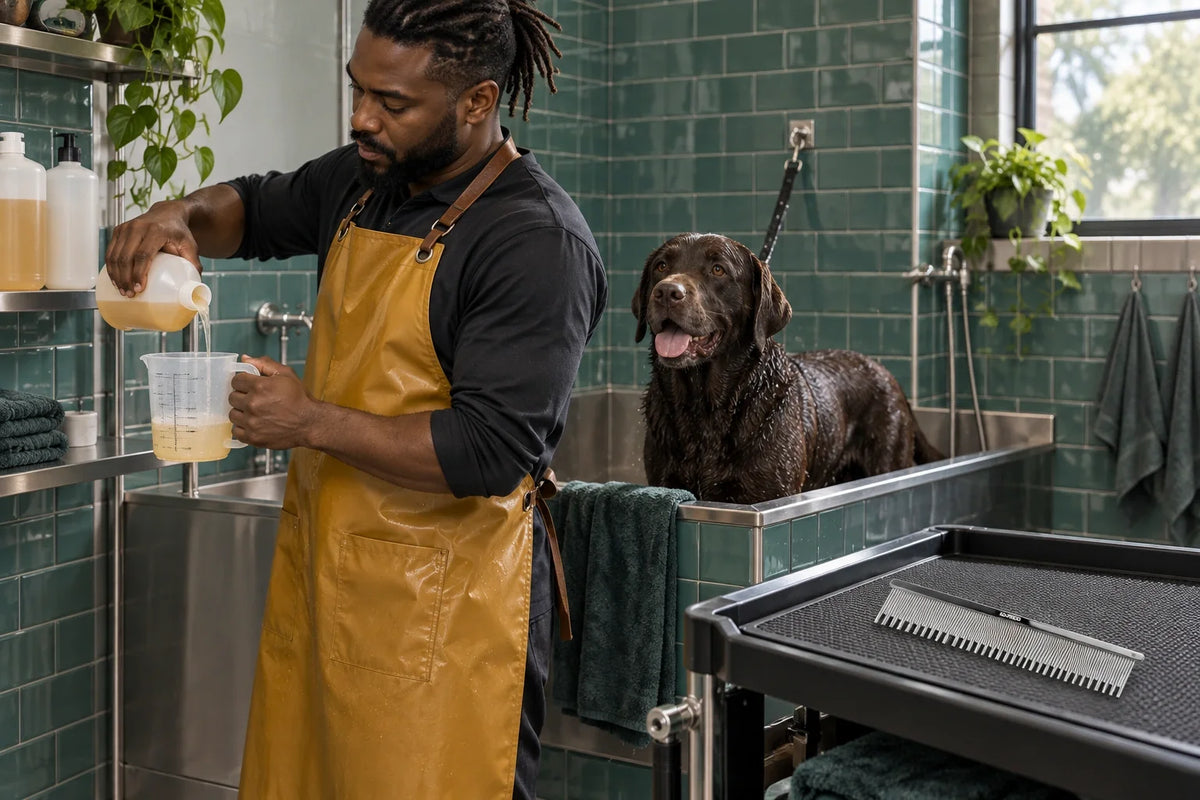
A note saying “dilute 10:1” can hide a surprisingly expensive mistake. Does it mean ten parts water plus one part concentrate, or one part concentrate in ten parts of finished mixture? Those instructions produce different strengths.
Never settle that question by habit. Read the actual product label, including which number refers to water, and ask the manufacturer if the wording is unclear.
Write the instruction in words first
The Skills England dog-groomer standard requires bathing products to be prepared according to the manufacturer's guidance. A ratio remembered from another bottle is not that guidance. See duty 4 of the occupational standard.
On your working mixing chart, turn a confirmed instruction into plain language: “ten parts water plus one part product”, for example. Include the product name, intended use and where the current directions can be checked. Do not make an unverified shorthand the instruction everybody else inherits.
Count all the parts in the finished mixture
If the label specifies ten parts water plus one part concentrate, the finished mixture contains eleven parts. For a chosen finished volume, divide that volume by eleven to calculate the concentrate, then use ten times that amount of water.
| Illustrative instruction | Concentrate | Water | Finished volume |
|---|---|---|---|
| 10 water + 1 concentrate | 50 mL | 500 mL | 550 mL |
| 10 water + 1 concentrate | Approximately 45.5 mL | Approximately 454.5 mL | 500 mL |
| 9 water + 1 concentrate | 50 mL | 450 mL | 500 mL |
These are arithmetic examples, not dilution recommendations for a particular shampoo. They assume the instructions measure liquid volumes. Use the units and method the manufacturer actually specifies.
The last row gives a 10% concentrate mixture by this simple volume calculation. The first two give approximately 9.1%. Treating “ten parts water” as “ten parts total” changes the intended formulation.
Adding concentrate to a full bottle changes the total
For the first example, adding 50 mL of product to 500 mL of water makes 550 mL. Adding 50 mL of product and then topping up to the 500 mL mark makes a different mixture.
Choose a container with enough working capacity, and follow the specified order of mixing. A mark labelled “500 mL” should not have to mean both water volume and finished volume. Make that distinction explicit in staff training.
Measure at a scale your equipment can resolve
A large jug with widely spaced marks is a poor choice for a tiny dose. Select a dedicated measuring tool with suitable graduations, read it at eye level on a stable surface and avoid estimating through foam. Do not convert a volume dose into a weight dose unless the instructions provide the necessary method.
If the calculated amount is awkward to measure, select a sensible batch size that preserves the confirmed ratio and matches the amount needed. Do not round the product up generously and call it “a little extra cleaning power”.
Keep preparation and product strength separate
A patch that remains difficult to rinse or comb deserves an assessment of the coat, application and rinsing process. Increasing concentration does not correct every preparation problem.
Use suitable VUNRO tools for their actual part of the routine. The 6-inch Silver Double Skip Pin Comb offers a different pin arrangement from the 5-inch Coarse and Fine Straight Comb. Select the tool and section for the coat, work without dragging, and keep cleaned tools apart from those awaiting cleaning. Neither comb is a reason to change a bathing product's directions.
Make the next batch reproducible
Before using a mixture, check the product, the confirmed ratio, the measured quantities and the prepared container. Follow the label's preparation, use and storage requirements. Do not top up an old mixture or assume a diluted product has the same storage life as its concentrate.
Keep only the mixing chart that belongs to the current product. Recheck it when the formulation or instructions change. A two-minute calculation once is more useful than a slightly different guess at every bath.
Sources and further reading
Skills England: Dog groomer, ST0943 v1.1. The calculations are illustrative arithmetic. For the separate issue of bottle hygiene, read The Dilution-Bottle Problem.
Keep learning
More from the Blade Blog

The Dilution-Bottle Problem: What Grooming-Product Cultures Found
Read the guide →
How to Prepare Your Dog’s Coat Before Clipping
Read the guide →


